Rick's Journal

Tuesday, October 2, 2012

The Newfoundland Expedition, August 2011, Part Xl


Making Breakfast in the Gros Morne Backcountry!

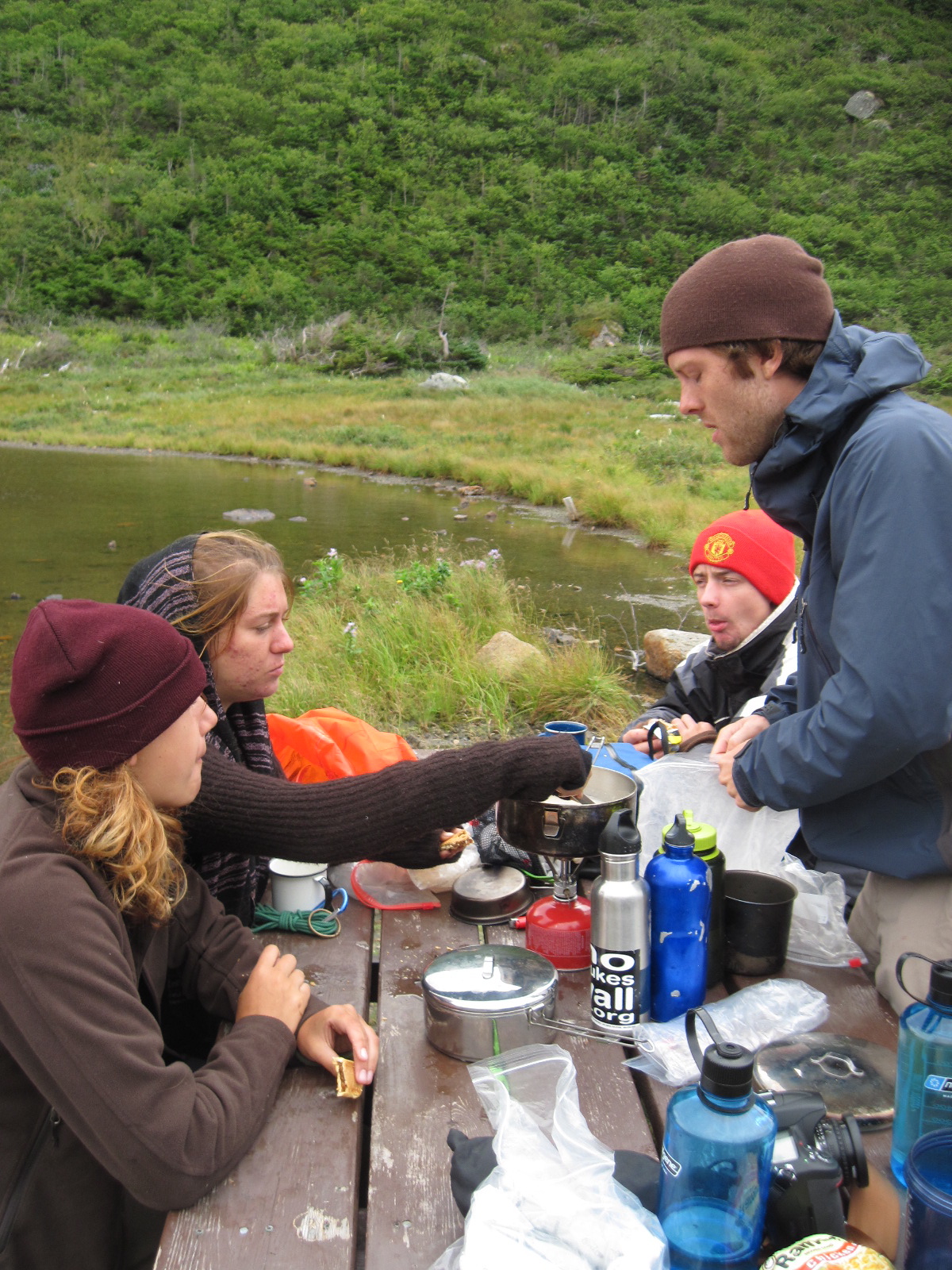
 We awoke on the eleventh day of our expedition, and had a hot breakfast of oatmeal and other cereals.  Hot chocolate was served.   Ben made tea, which Abigail and Nicole had also.  Japhy also had some really funky superfood cereals that got mixed reviews by those who tried it.   I took a pass and just stuck with my cream of wheat or oatmeal.  I forget which we had!   It was still pretty cold, so we huddled around the picnic table and tried to get a little warmth from the two stoves as best we could.

Down the mountain we went, one step at a time.  The sky was blue and clear and it warmed up quickly, and I was happy to be there, and sad to be hiking out and heading south to catch the ferry the following morning.  There trail was good, and I picked my way carefully, to make life a little easier on my aching ankles and knees.  However, our packs were light and the view was good.   I took very few pictures at this point, preferring to just absorb it all and not be in a big hurry to get down.

A wizened old spruce or tamarack tree near our campsite.
I got to the trailhead and found my companions snacking away, rested and having lunch.   We had to repack the car a little, and then we headed out of the park, and south, towards the southern tip of Western Newfoundland.   We were all a little quiet on that part of the ride, as I remember it.

Unripe Crowberries along the trail
It was nice to see this part of the land, because on our way in just a few short days ago, it had been raining and dark so we hadn't seen much except the highway.   I don't know what it is, but I really liked seeing the way the roads wound around the mountains, and the small houses, and the Hydro power buildings that looked like they were about a hundred years old, and the little differences in the stores, gas stations and buildings from what I am used to in New York.
We made it!

I could feel how this place, this 'Newfoundland', had changed me.   We drove south, out of Gros Morne Park, along countless trees, wild rivers and modest houses, listening to CBC, Canada's version of NPR, and thinking...

A close up of "The Big Erik" as
well as the seafood platter, which
Ben and I are having on the left!
Everyone was pretty hungry so we ended up stopping in Corner Brook at C & E's Fish shop, and yes, I did get the Seafood Platter, just for old times.   I wasn't alone, either!    The food was fresh and good, and it felt wonderful to recharge after our hike and the cold and the mountains.   We just sat there, eating outside, in the fresh air, trying to absorb it all.  The culture, the way people talked, the trees and stores and the feeling of expansiveness, and wildlife and possibility.   Yeah, we got that much out of a plate of greasy battered fish!   Okay, maybe it was just me, but there it is.

Heading to Port aux Basques and Corner Brook.
The sun was slowly setting as we made our way down the coast to the small JT Cheeseman Provincial Park, which actually had wifi if you sat on the right bench outside of the ranger station.   We took showers, set up the tent, and were sad that the sun was gone so we couldn't go out on the trail to the ocean to see the waterfalls and the beach before we left.   It was clean, like all of the park facilities we had used on our trip, and our tent site was private and grassy and awesome.

Port aux Basques, in it's natural
cloudy habitat...
Nicole and I went into town for some supplies for breakfast, for food for the ferry ride in the morning, and to just see Port aux Basques.  At night, it is a true, working class town, and it reminded me of a number of factory towns I have lived in or passed through on my travels in years past.   There were fish and chips stands, and places to get clothes, boots, gear, and video stores.   We found a small store that was still open, and got our stuff.  I even got a small bottle of Iceberg Water, too, to show the family back home!

The cars line up to get on the boat.
We bypassed Tim Horton's, too, and got back for a good nights sleep.   In the morning, we packed up and drove the few miles out to the Ferry, and got in line for the boarding, about three hours ahead of departure, as usual.    Ben and Japhy and Abigail made breakfast out of the back of the car, fried eggs, I think it was, which cracked me up.  I had cereal and a banana...  
Parking on the ferry.

The comfy seats on the ferry.
Hey, it's a long ride!
Once we were on board, we found our seats, the big comfy ones near the TVs, but soon left those to explore the ship.   We wandered, checking out the shops, the internet area, the lounge area where someone was performing some traditional Newfie music.  We got some food, played cards, took pictures and brainstormed different ideas for heading back for another Newfoundland Expedition!
The dining room aboard our ferry.

It's a long ferry ride, and I had plenty of time to think.  I slept a little, wrote, read my book, and looked out at the Atlantic.   Nova Scotia was almost upon us, and the mainland was looming large in my mind.  

The view from my window, when the sun
emerged from the rain clouds.
This was the first trip I had been on in many years, since Javier was born, where I was totally exploring and wandering and not working at teaching or running a camp or other program type event.  My companions were great, crowded as we were in my little Xterra, with all of our gear in the back and on top.   I thought of home, and I was looking forward to being home too, to see Trista and Javi and everyone back at Hawk Circle, and the land as summer moved into fall.   I could have stayed another few days, but I knew I would be back, and that made it feel less somber.   Besides, all of my timber framing sore muscles were feeling pretty good and healed up, too!

Playing Cards on the Six Hour Ferry ride back to Nova
Scotia.
There are two more stories that I have to relate pertaining to our last days heading back to New York.   Once we got off the ferry, we drove through Nova Scotia, which is beautiful, too, by the way, and as we headed south and west, we searched for a place to get seafood, you know, like, fresh lobster or fish or something.   I mean, we were right there, by the ocean, all of the time, so it was like, 'C'mon, what do we gotta do to get some shellfish around here?!!!!'.   Anyway, we drove for about an hour, and the sun was beginning to set, when we saw a huge place that advertized "Fresh Lobster Dinner: $9.99".   It was pretty touristy, but we decided to take a chance, and it was the only place we had seen at this point.   Plus it was right by the highway.  

Abigail caught me in a reflective moment on the ferry,
as I thought about our trip.
So we get out, and see huge racks of T-Shirts, sweatshirts, hideous nick-knacks and tacky trinkets that advertised New Brunswick, Nova Scotia, Newfoundland, Canada in general.   But the real freaky thing was, as we got out of our car, this guy, who was about fifty or maybe sixty, came running out and lights off these bottle rockets and fire crackers, and tries to give us sparklers!   He asked where we were from, and invites us in, and pours us ice water into paper cups.    His eyes were kind of wild, and he cornered Abigail and Nicole, who are too nice to tell him to back off, and started asking them all kinds of questions about the US and Obama, and stuff like that.   I cruised through the crowded crap in the shop and found a section that looked like there had been a dining room at one point, where they might have served food and lobster about fifteen years ago, but it was all covered in papers, clothing, boxes and conservative slogans on computer paper.

Our misty campsite, somewhere in Nova Scotia
I determined that we needed to get out of there right away.   I hadn't drank any of my water (if that is what it was) and gave the signal to get back in the car.   The guy started asking me if I was Jewish, to which I said no, but he didn't believe me.  He asked me what my name was, and when I told him, he started talking about illegal immigration.   I know he spouted a bunch of stuff like:   "Just because we live in Canada, we know what's going on down there in the States" and he sounded like a lot of conservative talk radio hosts in his babble and talking points.   I felt like I was so close to turning around and walking back to him and his diatribe, but I saw the look on the faces of my companions, so I just got us all in the car and we took off.   It was a long while before we all felt normal again.
The stomping deer tracks...

"Did that just really happen?" I asked several times.    We never did get our lobster dinner.

We ended up driving through the rain, and stopped at Boston Pizza, a Canadian combination of Applebees and California Pizza Kitchen, and then we listened to a science fiction audio book deep into the night.   I finally was able to drive no further, and we pulled off the road at the same location where we had stopped and had dinner on our first day in Canada, two weeks ago!   It was an old logging trail, and we drove up and parked, set up our tent and fell fast asleep.   I vaguely remember hearing the alarm snorts of deer all around our tent in the night, but it wasn't enough to rouse me to do anything except turn over.   Coyotes also howled and yipped, to the same response.   In the morning, before everyone got up and packed, I checked the rough road for tracks and saw some great impressions of a deer stomping the ground in alarm, which was cool.

The second story was how we kept hearing on the radio news about Hurricane Irene, which was barreling up the coast and supposed to wipe out New England, and everyone was battening down the hatches, so we made good time through Nova Scotia, New Brunswick, the Border Crossing and into Maine.   Once in the USA, I felt an immediate difference in the culture, as we got gas at an exit near Baxter State Park.   Cars and SUVs with canoes and kayaks on top were all around us, heading back home, even though it was only Saturday, to escape the storm.   The store clerks basically ignored me as I shopped, and I knew I was back in America.    We got our gas and headed south.
The Hawk Circle Bridge, after Hurricane Irene, August, 2011

We drove through Maine but as we got closer to Boston, the traffic was just stopped.   We just inched along, so we took the first exit and headed down some back roads going anywhere west and south, trying to circumvent the traffic.   I don't know if it actually saved us time or not, but we saw a lot of run down mill towns in New Hampshire, and some that were nice and coming back, too.   Then we got on the Mass Pike and our speed improved.  

To make a long story short, it started raining and we saw utility truck after utility truck driving the other way, to begin making repairs I guess in anticipation of the storm.   So I just kept on driving, determined to make it home before it hit.    I don't really remember that last hour back past Albany, which is scary, but we made it, and got to sleep in our own beds, through the rain and wind and wild weather.

By noon, our bridge boards and timber framed railing had been washed away, as the sheer volume of water was so intense that what normally takes 36 to 48 hours of steady rain to make the creek rise to flood level happened in 12.    There was no way to cross.   The Schoharie Creek had flooded, and bridges were out all around us, to the south, east and even the north and west of us.   Her flight home to catch her trip to Vietnam had to be delayed by a day, but eventually, she made it home, safe and sound.   We rebuilt the bridge, sans railing, and life went on.   It was a climactic ending, literally, for our trip north.

(Editor's Note:   Sorry this last segment of my trip has taken so long to write and complete.   It has been a very, very busy and eventful year, and I promise I have a ton of new things to get out in the next week or two.   I hope you enjoyed reading about our adventures and our time in Newfoundland, too!)

Sunday, February 26, 2012

The Newfoundland Expedition, August 2011, Part X

Heading for the summit!
 This post is going to have a lot of pictures.  However, I won't make them all full sized, since you can click on the pictures and go to a full sized slide show of each of them in massive detail, so I will let you check most of them out that way.   So click away and enjoy!
Saying goodbye to Ranger Harold!

Okay, on with the show!

Today we started with breakfast, and packing up our backpacks for the climb and overnight on Gros Morne mountain.   Abigail was feeling a lot better, getting good sleep, and the trip was a go for her too, which had been a concern and factor as to whether we all went up or some stayed and some went.   We were doing our dishes and packing the truck when the green park services pickup truck rolled into the kitchen shelter parking area and Ranger Harold Snow hopped out.   He was the ranger that took us on the hike to Bakers Brook Falls, to see the big moose up close, and told us stories about living around the park that we loved.   He told us where to go to take some good pictures up on the mountain, and to bring warm clothes, his final pieces of advice. We said our goodbyes and then we headed out.
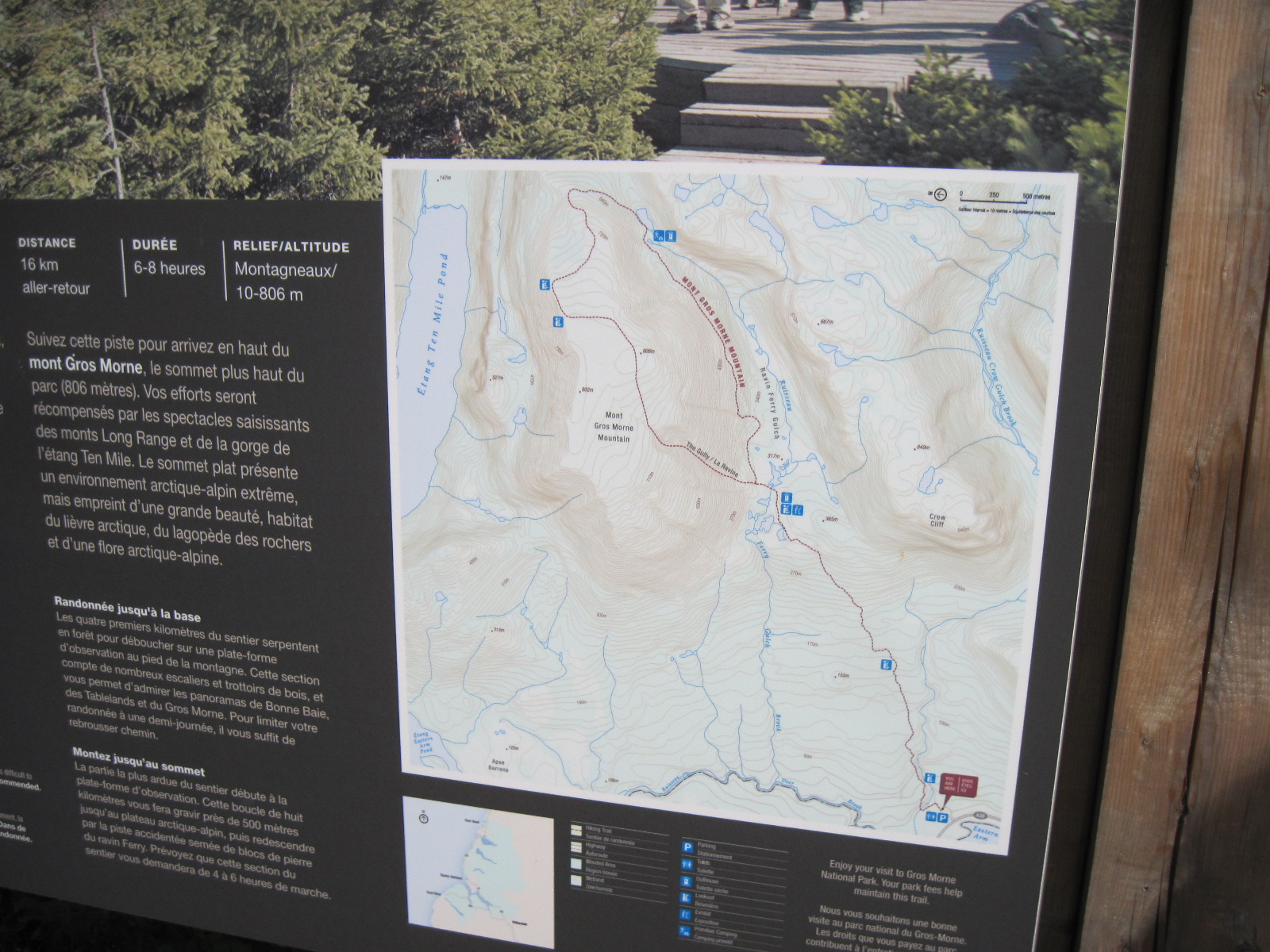
The map at the trailhead.

Gros Morne Mountain, from the trail.
We stopped by the Visitor's Center and picked up our backcountry passes.  The ranger there told us that we have to be on the lookout for a bull moose that was hanging around the pond near the camping area and to give him a wide berth and not bother him.   The reports were indicating that the rut was starting a bit early and he seemed aggressive, and they didn't want to have to interfere with him due to a bad interaction between the moose and people.  Which we understood and agreed with, of course.

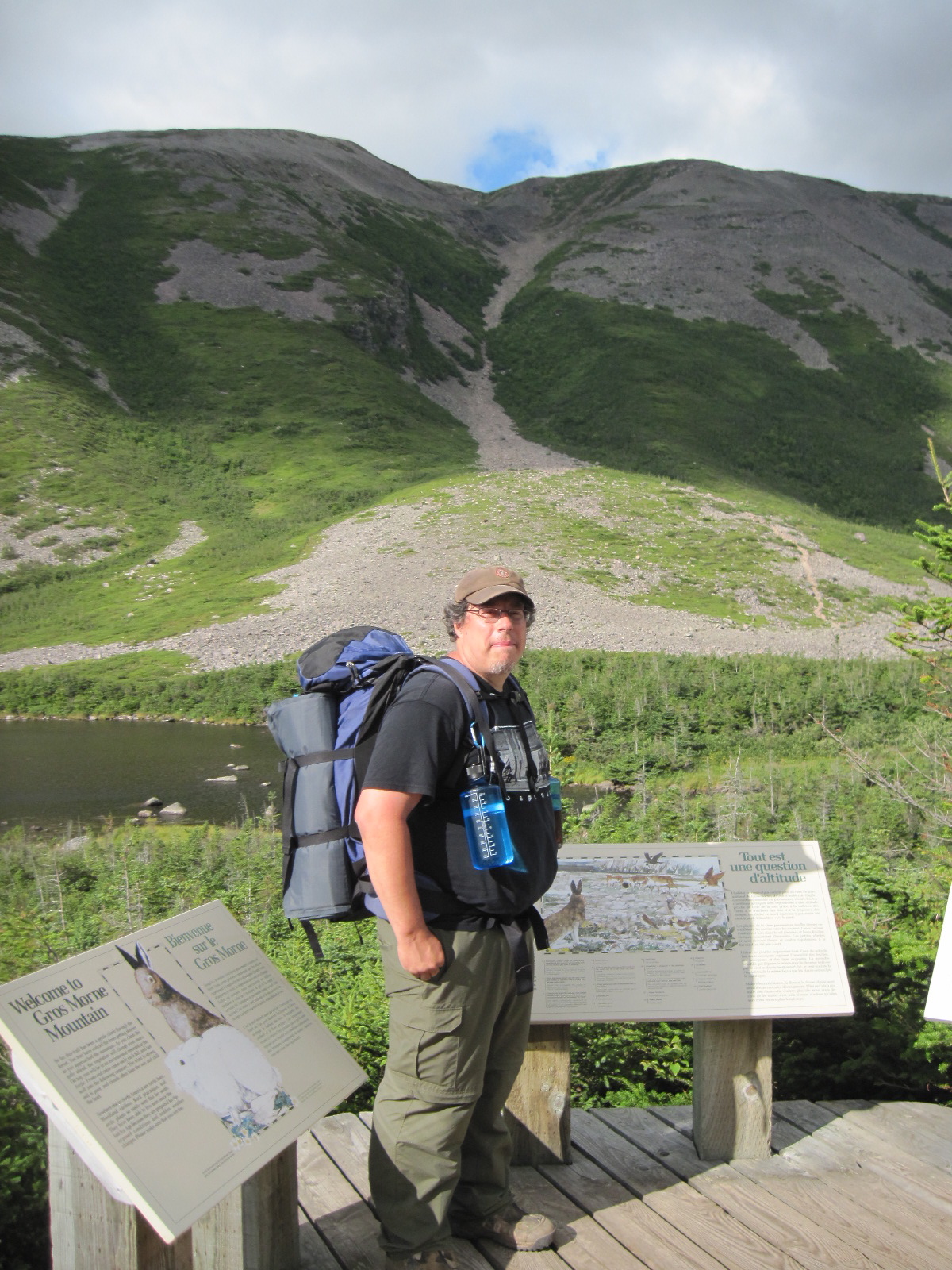
We have to ascend the steepest
part of the mountain in "The Gully"
which is viewed behind me.

The boardwalks were great
in some sections along the way.
At the same time, some of us where checking our email and Facebook accounts and found out there was an earthquake in the DC/Baltimore area, so that was pretty unique too!   We didn't feel it up in Newfoundland, though.

The rangers also told us that if the top of the mountain was shrouded in fog or clouds, or the wind picked up too much, that we should not try to ascend because of the dangers of low visibility, cold, hyperthermia and injury.   The weather looked sunny and great, so we were excited, but she explained that it could turn very quickly, and that at night the clouds descend as well and that we should make sure we were at the campsites before dark.  

A small pond at the base of the
mountain.  We are about to leave
most of the trees behind at this point.
Eventually, we headed out and up to the trailhead, shouldered our packs and headed up.   It was fairly evident in the first fifteen minutes that most of the group was going to be moving a lot faster than I was, so I stayed at the end of the line and they sprinted off ahead of me.   My pack wasn't really that heavy, since we were just going for one night, and it wasn't anywhere near as heavy as it was just a few weeks ago when I led the Adirondack Expedition back in New York!  Still, it seemed to get heavier in proportion to the climb.

At the last stop before
heading up, up up!
Looking at this view, I can only say
'This is why we came all this way!'
The trail up was good, with lots of wooden stairs and wooden boardwalks at times, as well as fairly clear  paths heading up through the woodlands to get to the base of the mountain.   There were a few places to stop and rest, and I caught up with the group at those times, and took some pictures and checked in with everyone.   There were a lot of people heading back down the mountain, who had already been up early and hiked it up and back already.   Most of them looked very sore and tired.
The lichens that grow on
the rocky scree on the
mountaintop.

One kid who was about thirteen or so looked like he had been crying on the way down, and gave me a baleful glare like I was the one who had tricked him into going up the mountain.   His mom looked pretty guilty and didn't even look me in the eyes.   Others were in great shape and all, but were still pretty happy when I told them they were pretty close to the trailhead.

Stopping to admire the view in the
Gully.
I stopped along the way and took pictures and a little video of blueberries, partridgeberries, snowberries and bunchberries.   I thought it was a good way to stop for a very brief break and take videos of the trail, the view, etc.   However, when I got home and then downloaded the video, I could hear how out of breath I actually was!   Anyway, I am not sure how much of it I will use, but we'll see!

A good sized cow moose, browsing
near the Gully trail.
We reached the last trail resting point and saw our way up the Gully, which was a long, rocky gorge that goes straight up the mountain.   It looked intense and I felt a certain sense of foreboding and excitement at the same time.   Everyone else looked well rested and ready.  We took a few pictures and then shouldered our packs and headed up.  

At times, the Gully trail seemed to
go pretty much straight up!
When we got to the bottom of the gully, there was yet another sign warning us to not attempt the climb unless we could see clearly and the weather was good.  We went up, since we had fairly clear skies and a nice breeze.    By the time I got a quarter of the way up, I could see Ben and Abigail moving through the narrows, where the trail was partially obscured by brush and small trees.

On the summit, it was surprisingly
flat and very cold.
The trail started to close in on the sides as I approached the narrows, and I stopped to take a little video of the 'trail'.  It was basically laughable, as it was virtually indistinguishable from the rest of the rock shards all along the gully and mountaintop.   This kind of rock mix is created when the surface rock is frozen and refrozen until it breaks into smaller and smaller, sharp edged rocks called 'scree'.   They were jagged and sharp, and many were large and tilted and shifted on almost every step.   You had to really pick your way along and head up, up up, and I wanted to try to record what it was like to hike this trail, the views and everything.  
Abigail, Rick (me), Japhy, Nicole and Ben.  
We made it, and after celebrating for about three minutes
we had to quickly change our wet clothes and put on
wool sweaters, hats and layers!


I finished recording and then I heard a noise of something moving through the brush.   I turned and looked behind me and there was a moose, browsing on alders and spruce saplings, seemingly oblivious of my presence.  I was a little closer than I would have liked, because I couldn't really run away very easily on the sharp rocks, should she charge me, but I sensed that she was fine with me being there.   In any event, she didn't seem to indicate that she saw me except by the motion of her ears moving backwards from time to time, listening to my slight and quiet movements.   She moved into thicker brush and I began climbing again.
The view to the north on the northern edge of Gros Morne mountain!

When I started walking down this
wooden stairway down the mountain,
I felt a lot like Po on Kung Fu Panda!
My knees and ankles were saying
'My Arch Nemesis: Stairs!'
I guess I will skip ahead to the part where we made it to the top, and we were all on the summit and took a picture!   When I got there, Ben had already taken a video of some Arctic Ptarmigans, and Japhy had gotten some good pictures of an Arctic Hare, and they were bundled up with wool sweaters, hats, and lots of warm layers and jackets.   I was so hot I didn't know if I would do that just yet, but three minutes later, the wind was so steady and strong and cold, I broke out my sweater!  

The mountaintop trail!
The top of the summit was covered with broken rocks, lichen, tiny windswept willows, alders and native berry shrubs.   It was flat and looked like it was just about to snow.  The cloud ceiling was literally a hundred feet above us, and the cold air was filled with moisture from the massive oceanic bay of the Gulf of the St. Lawrence to the west.   The sun was beginning to set, and the light was thick with every color of the spectrum.   The warm, wet air pushed up the mountain and fjords, and we could see the air turn into clouds right before our eyes, as it condensed.   It was awesome!

Where the mountain air turned to
clouds before our eyes!
The top of the mountain had long stretches of rocky paths through the barrens, and also some boardwalks, which were mercy on my sore ankles and knees!   I was wearing some hiking boots that I used for hunting last year, and they really didn't feel that great.   We went along the path to the edge of mountain on the far side, and saw a view that there was just no words to express how amazing and beautiful it was.   We loved it, despite the cold wind.  
This was a great, great moment, standing here!

We took a lot of pictures, and just stood there, seeing a landscape that was virtually unchanged for centuries.   It took my breath away.   I saw waterfalls coming off of the distant cliffs, and inaccessible ponds and rivers and streams that beckoned my imagination for probably the next three weeks at least.

There were a lot of photos taken
at this spot!
The sun began to sink down lower and lower, and we still had three or four kilometers to get to our campsite, so we reluctantly pulled ourselves away and began to move down the trail down the back side of the mountain.   I saw what I think were caribou tracks and moose tracks and moose droppings, too.  I found a ptarmigan feather that was so white and pure, it startled me.  It was a wing feather, one of the primaries, and it had a black stripe on it and some grey speckling close to the quill.  It was almost exactly like a ruffed grouse primary, except it was so white!   I felt so good just to see it and hold it in my hand!   There were a few other feathers around, breast feathers and such, so I thought maybe a falcon or an eagle had a snack on this bird, but maybe it got away....

Abigail captured me lumbering
along the trail.  She was slow
because she was taking lots of pics.
I was slow because I was slow!
The view looking East...
Abigail poses in front of the pond
near our campsite.
Then came the stairs.   It was like a temple, only it was going down, down down.   Seriously, it was amazing and scary, all at the same time.   And I will tell you one thing about stairs after climbing the Gully:   Going down hurts!   I guess I am going to sound like I am too old to be hiking the mountains, but I am just keepin' it real, people!   The stairs were just a little too tall, so each step dropped you down far enough that your thighs got an amazing workout, or just about killed you, depending on your age, I guess!

Can anyone guess what this is?   
The bottom line is, I made it.  But the next thing we saw on the trail was moose droppings.   A big, whopping pile of it, and it was fresh.   Remember the warnings from the Rangers?   Despite the pain, my memory was still alive and kicking, and I knew we had to be careful and aware.   I caught up with Abigail, and then we saw it.  A huge black shape in the brush at the northern edge of the pond.   It was big.   It looked like two moose!   I could hear it move and it sounded like ten large trees were breaking under it's massive hooves.   We both froze, and then we tried to get a picture, but it was too dark.  There was no way to get a good shot, but we tried.   And I was hoping my zoom would let me get a glimpse of it's rack of antlers.

No deal.   We moved very quietly, stealthily down the trail to the other side of the lake and met up with the rest of the group.   We set up our tents, and started our dinner.   I think it was burritos, with refried beans that were dehydrated, and lots of cheese and salsa.   It cooked quickly, but with four ravenous hikers staring at it, the pot took forever to boil.   Then we had cookies, and it was good!

Our small camp on the
edge of the pond, behind
the Eastern edge of Gros
Morne Mountain.
However, the wind began to howl, and it was freezing.   I had changed my clothes as soon as we stopped hiking, but that cold was cutting in deep.   We cleaned up and I dove for the tent and my warm sleeping bag.   I loved that thing, seriously!   It felt so good to be curled up and feel my own body heat radiate around me, relaxing my muscles.   I was sleeping in my little tent, nestled in the ancient mountains of Newfoundland, dreaming in this ancient land, surrounded by wildlife that seemed to have no fear of us, and the strength of the mighty stones!  

It was a long, good day.   I thought for a moment or two about the sharp hooves of a bull moose taking a disliking to finding a tent near the shore of his pond at the beginning of the rut, but maybe the burritos were a good call?   We didn't have any problems, and I was too tired to care!

Wednesday, February 22, 2012

On the Lookout for Teaching Materials: The life of a wilderness skills instructor.

This milkweed grew it's whole, six
month life in view of this country road.
Now it will live in our barn for a while
and then maybe for a few years
as a necklace or bracelet for a young
person's first natural fiber cordage.

 So, last week, I was driving down some back roads through the Catskill mountains, on my way to teach cordage with natural fibers to about 25 fourth graders, when I noticed some long, white plants clustered in clumps along a guard rail.   There was a good shoulder and room to pull over, so I did.

I put my flashers on and hopped out to take a look.   The plants were milkweed, and they had been dead since November, and slowly decaying and going back to the soil.   The surrounding grasses and plants had also died, and the little snow that we had this winter had pushed it down close to the ground, but the milkweed's white stalks had many that were still standing.   This is due mostly to the strong fibers contained in the bark of the stalk, that helps keep them upright through all kinds of weather throughout the plant's short life.   It also makes the plant valuable to anyone in a wilderness survival situation, or who loves natural fibers!

The whiteness of the milkweed stalks stand out
from the browns and tans of the other
roadside vegetation, even at highway speeds,
if you are on the lookout for them!
I collected as many as I could, gathering the ones that were upright or laying sideways but not directly on the ground, as the ones on the ground are usually too far decayed to be used for cordage.  Also, stalks with large dark grey splotches, or black ones, are almost always rotted under the bark to the point where the fibers just crumble and break.   One of my instructors, Tim Brown, told me that he only gathered the white stalks because they were be best, most silky fibers of any milkweed he gathered, and he stopped wasting time on the grey ones because it just saved time sorting.   I think he is right, because it's the same thing that Sam Thayer says about gathering acorns.   You don't want to just gather every single acorn that you see and then have to sort them later, but instead sort as you gather, so you save that extra step and can then process only the best!   It makes sense, doesn't it?

The back of my car, with assorted timber framing
and program gear, now with my collection
of several roadside stops of milkweed.
I got as many as I could carry and put them in the back of my car, and continued on my way.   They were a little wet, so I had to make sure that they were dried out when I got home and spread them apart to dry in the barn.  I have bundled them up too soon in the past, when they were a little wet, and the whole bundle got really moldy and were ruined, wasting all of that time, effort and fibers!

Once they are dried, I usually bundle them in clusters of thirty stalks or so, enough to give each kid a couple of stalks to make a necklace or bracelet as they are learning to process and twist the fibers into a nice reverse wrap.

Drying the stalks in the barn so they don't get moldy.
(Note:   Be sure to take the seed pod heads off of the stalks if you can, because they will explode in silky seed whiteness everywhere if they stay in the back of your car and dry out because your car gets hot.   I have come back to my car to find it covered in fluff that is very hard to get out because it clings to everything, and the silk filaments break easily and are not good to breathe.   Don't learn the hard way like me!   Also, in these photos, the stalks and pods were wet from rain, so I didn't have to worry about that, but you might not realize that in the photos, hence this important tip!)

Close-up of my milkweed stalks.
As I was gathering at my next stop, I thought about the time needed to gather and prepare all of these materials for our programs.   It adds up!   We gather dogbane, arrow shafts, atlatl dart shafts, mullein stalks, goldenrod, horseweed and even some swamp milkweed from time to time, all through the fall, winter and early spring.   We gather certain grasses for tinder, or for insulation demonstrations, and grass mats.   We clean, bundle and prepare them, storing them in our barn or staff cabins so we can run programs all year round.

It doesn't stop there, though.  We also look out for cedar, poplar, cottonwood or basswood logs for spoon blanks, bow drill sets, coal burned bowls, hand drill fire boards or animal carving.   These we have to select the straightest sections without knots, and cut them to the right lengths, as well as split them into smaller sections and then dry them both in the sun and wind, and then place them up in the high spots in the barn to fully season and dry.   It takes a long time to cut up 100 bow drill sets in rough sections!

My milkweed bundles, all tied up
and a random bundle of dogbane!
The silky silver white fibers of milkweed!
One of the main reasons I wanted to post about this topic is to point out to instructors and mentors that these gatherings take time, and unfortunately, you can't just go out and buy cordage fibers or bundles of milkweed at the store, and you have to do it at the right time and plan ahead...   There is a value to these things that you have to be sure to add to your fees as you work, and make sure you understand this as you build your business, so you don't work for free and get burned out.   It seems simple to understand, but if you aren't familiar with running a business, it is easy to forget or let it slip through the cracks.   Likewise, it sometimes is the business manager who gets 20 classes signed up, but unfortunately forgets to make sure that you actually have enough milkweed/dogbane/bow drill kits, etc to run the program!   In those times, you have to scramble and think fast, and do what you can to make do, but in the long run, to preserve sanity, you have to make sure you plan that time in your seasonal schedule for that kind of gathering!

When you find the seed pods on the stalks, be sure
to scatter them around sothey can find a good home
and grow more milkweed!
Remember also, that kids are going to be doing the carving or processing, and we want to have good results, so be sure to discard the junky stuff so you don't make a third grader try carving a spoon out of a piece of wood with six knots in it!   Save those pieces for your staff!   (Ha ha, just kidding!)   The survivalist part of myself always thinks that someone will be able to make something cool out of interesting materials, but unfortunately, it often means you will have a box of mostly un-useable chunks in a year or two.  Throw them in the fire and move on to the good stuff, people!   I have a story one time where I was going to a home school group to teach cordage and fire making, and my staff assured me they had plenty of wood and bundles of milkweed for the class, and when we got there, you guessed it!   We had three bundles of crumbly fibers that were useless, and the box of cedar wood for bow drill sets was pure Knot City.   Bad for carving bow drills and fireboards.   Very bad.


So, we were lucky to go to a local feed store/landscaping supplies, and bought a cedar fence post that had almost no knots.   We sawed it up, and it worked out.  We had to pay about $30 or so, but it was worth it to pull the workshop off!

My bundles, safely stored in our barn until
we need them for our school programs,
summer camps or apprentice program.
The cordage was harder.   We found some raffia fibers at a craft store (Michael's, I think it was) and used that, but we also were able to strip off some green tree fibers from some basswood shoots that were growing on a roadside tree, and we cut a few off and brought them to the camp and let the kids peel their own and then twist it up, and they loved it.   However, while I can celebrate the fact that we made do and were successful, it it is also true that I was sweating bullets and working hard to solve the problem, rather than spending that time connecting to kids and parents and relaxing before the program and getting our group plan together.   It is good to have things run smooth, and good preparation will help your programs have less stress, less effort and great results.

It's all about the details, right?   If we take care of the little things, we will be on our way!

Anyway, with this warmer winter and less snow, you should be able to see the roadside weeds pretty easy in some places, and you can be on the lookout for milkweed and other plants for your own practice, crafts and programs.   Good luck and happy gathering!