Rick's Journal
Showing posts with label Icebergs. Show all posts

Thursday, October 27, 2011

The Newfoundland Expedition, August 2011, Part Vl

The Norse Sod House at L'anse aux Meadows
Part Six of our Journey begins with a great breakfast of pancakes and then we headed up the road to L'anse aux Meadows.   It was overcast, and the clouds looked like lead waves across the sky.   It was cold, too, but I was too excited to worry about it!   We were heading to the first Norse site in North America!

I had done some research about this place before coming all of this way, but I will admit that I didn't spend days on it.  I did this deliberately, because I wanted there to be something new to discover and enjoy that process when I got there.   So heading to this site, this World Heritage Site, meant being open to learning something new.

The Commemorative Sculptures of the meeting of the European and Native Cultures
 at L'anse aux Meadows, Newfoundland, Canada
A reproduction of a small Norse
sailing vessel
At the entrance to the park, we stopped to watch a huge bull moose browse in a bog off of the park road.  It seemed like a good omen, and yet we didn't take as many pictures as we usually did.   It wasn't really something we talked a lot about, visiting this site, but we were all seemed to have a sense of anticipation about being so close.

Abigail and Nicole
inside the Norse
Sod House
The visitor's center is a beautiful building, very modern and yet nestled in against the hill in away that seemed almost natural.   We got inside and the exhibits started immediately, describing humanity's origins, and the journey we have taken from our humble roots in Africa across the vast ancient continents.   It illustrated the journey of one group that moved across Asia, down into  Southeast Asia and Australia, as well as north into Siberia and across the Bering Strait.    That group moved downwards through the Americas all the way to the tip of what is now Argentina, as well as across North America.

The Norse Blacksmithing Shop
Close up of the
Sod House Peat Wall
The other group moved throughout Africa, the Middle East and then through the Mediterranean, and northern Europe, and eventually, north through the Black Sea to Iceland and Greenland.   Of course, this took centuries, and our ancestors adapted to these new climates and environments that defy description in their variations and complexity.   Eventually, the Norse seafarers sailed to the tip of Newfoundland and created a settlement there for several years.
Door Carvings to the Master's
Sleeping Quarters

Norse Tent looking out towards
Labrador and the bay
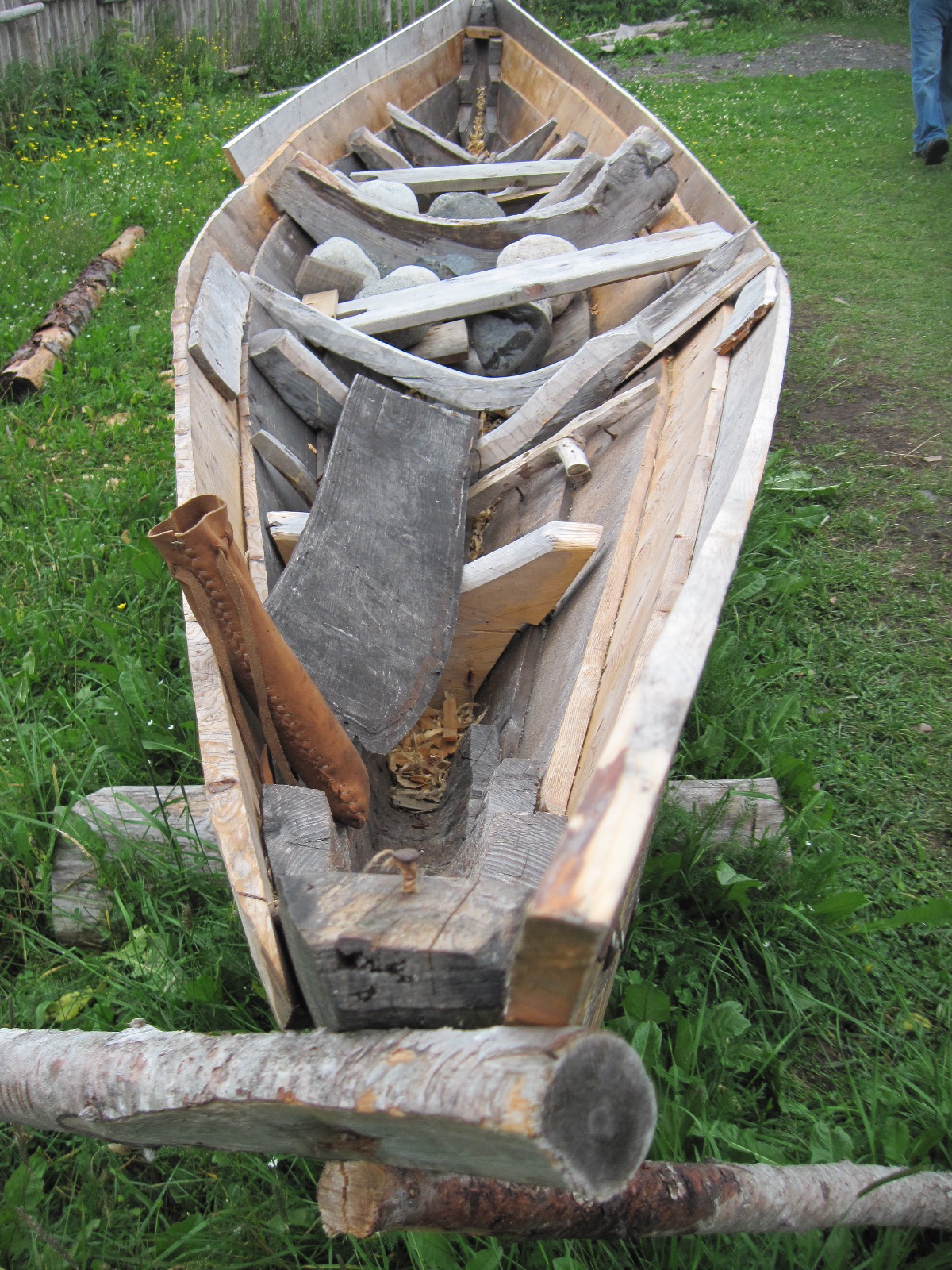
A boat in the process
of being built from
local wood with
authentic tools
The actual mounds left from the Norse
Dwellings from 1,100 AD
The thought of humanity's journey had never really occurred to me in quite this way.   I moved through the exhibits with care, reading each one and looked at the archeological evidence that the scientists discovered and verified this site's Norse authenticity.   We watched a video of the discoverers, and then we headed out on the tour.

Our tour guide was born and raised in northern Newfoundland, in one of the tiny communities that hug the coast, and her stories and heavy local accent added a lot to the presentation.

We saw the mounds where the Norse dwellings were located, now covered in thick grass overlooking the cove and the ocean, along with a few rocky islands.

Close-up of the Norse Boat
After the tour, we entered the Sod house, which was made by stacking 'bricks' of peat, into very thick walls lined with poles, and even covered the roof of the house, upon which grew thick grass and wildflowers.

Charcoal for the Forge
The Charcoal Pit
Inside, the house was very dark but cozy and warm, with several interpreters who worked on crafts and explained how life was like in the Norse community, 1,100 AD.   We saw the blacksmithing forge, but unfortunately the blacksmith was off on the day we came, but the forge was great to see.   There was a charcoal making pit, as well as barrels where they broke it into small pieces for use in the forge to get the iron ore extremely hot.

Ben samples the Brewis, a local fish dish
The woodwork involved in taking rough logs from the forest and crafting doors, planks, tool handles and boats was apparent throughout the site.   We saw carvings on the door to the Leader's Quarters, which, they explained, was designed to squeak and make noise as someone passed through to alert the sleeper in case of attack.  I guess it was an early form of security alarm!

It looked like the Norse would have had a busy day every day to gather firewood needed for the winter, food, fishing, making tools, building the houses, keeping healthy and tanning hides...   I don't think they were sitting around much!   However, it was very quiet and peaceful inside the Sod House, with a deep, earthy feeling that we really enjoyed.   It felt very similar to the native American Earth Lodges I have been in, and the area around their settlement was beautiful, clean and fresh

The Viking Burger

I walked back to the Visitor's Center on my own, soaking in the area.   I did not expect how deeply this meeting of the Human family, this convergence of Cultures, would affect me.  I saw cloudberry plants, moose tracks on the boardwalks and I spent time with the sculptures again too.   I could feel the courage and strength in the Norse travelers, in the Native voyagers who fished these waters and hunted these lands for thousands of years.   These peoples faced open oceans, fierce predators and intense climates using clothing and gear they made themselves with resources from nature, and their strength was steeped in the land all around me.   It wasn't just the Norse/Viking peoples, but all peoples who traveled far to rest on the shores, on the land where I now stood.
Mittens made from local craftspeople
with felted wool, at the Dark Tickle.
They looked very warm!

When we all regrouped at the car, we were in the mood for food.   The interpreters told us to go for the Viking Burger at The Northern Delight Restaurant in Gunner's Cove, so we had some ideas as to what to look for!    When we got there, they had a nice craft shoppe and art gallery as well as the restaurant, and we got some food.   Ben went for the local Newfoundland fare, called 'Brewis':

"Fish and brewis is another popular seafood dish. Brewis is hard tack, softened by cooking in pork fat along with the cod. The best part of this dish is the scrunchions, which are small, crunchy pieces of fat-back pork. They’re extremely tasty, and they make this meal. Fish and brewis can frequently be found on café and restaurant menus."
A Beautiful Scarf
At the Dark Tickle
 Japhy got the Mussels Special, which was fresh that day, and I forget what Nicole and Abigail got that day.   I got the Viking Burger, though I was tempted to get fish and chips!   Ben said later he wished he had gotten the burger, because it looked so good, but he was glad he tried something new for the experience.   I was proud of him!   For the record, the burger was excellent too!

After our meal, we found ourselves stopping at a small shop where a carver worked antler, whale bone and soapstone.  He told us stories of gathering berries, finding moose antler sheds, caribou and polar bear stories and how unusual the icebergs were to still be around in the coves.   We really loved hearing the stories of the local people, who were happy to share and exchange tales as we enjoyed the shops and crafts.

Heading into St Anthony
The next shop we visited was the Dark Tickle, (a tickle is the Newfoundland term for a narrow inlet between the hills, by the bay), and this place had everything!   Ice cream, woolen goods, (mittens, socks, sweaters, hats and scarves), lots of books, jewelery, great t-shirts, artwork and lots and lots of jams, jellies, syrups, teas, coffees and other locally produced goods.   The production line for their canning and preserving and processing was in the large room right off of the store, with huge windows you could look in and see the staff making the latest fresh fruit preserves!   It was closed when we were there, though, as we got there late in the day.

The Icebergs of St Anthony's Bight, looking across from the town.
All across Newfoundland I saw various cloudberry syrup, bakeapple jam, partridgeberry preserves, crowberry and squashberry jelly and much more.   The variety of berries in this northern place was amazing and I wanted to try them all.   I bought several different varieties to bring home for the family to sample and enjoy, but the best thing of all was tasting the actual berries out in the barrens, in the fresh, sweet ocean air, listening to the sound of gulls calling and the cracking and grinding of ice.

Young Newfoundland Entrepreneurs!
Another thing I had never seen before was woolen scarves and hats made using the Norse knitting method called naallbinding.   This is a beautiful method that makes for a durable, warm, thick product, and I got a DVD and a moose antler needle for Trista to learn with back home, since she is a crafty person and a knitter!   It is a great method, and the next time I come up to Newfoundland I will try to find someone who will give me a personal lesson in how to do it so I can teach others!

The coolest earrings I saw were made of arrowheads shaped from Newfoundland Chert, by Tim Rast.   I am hoping to see if we can visit him when we come up again and get some lessons and hear some stories about making native arrowheads, Inuit style points, etc.   His work is excellent, detailed and authentic!

We headed out again, and the sun had burst through the cloud layer and it was warming up.   We went into St Anthony, to get some supplies, check email and see if we could find some fresh fish to cook for dinner.  We were amazed to see more icebergs, bright and huge, crowding the bay.   These were massive, twice as big as a large New England Barn, and again, we were speechless.   The blue sky reflected deep blue streaks in the brilliant white ice, a color so incredible it looked fake.   It was like a blue raspberry slush!

We saw a cute roadside stand that we had to take a picture of, where three local kids were selling iceberg ice (by donation, actually!)   It was awesome, and their mom and dad came down and sat with us to enjoy the warm weather and sunshine.

It was an amazing day, one of the best (I always say that, because it's true!) and our experiences were growing in leaps and bounds.  Our companions were getting along well, and our food was good and there were new and unique things to see and do around every corner!

To Be Continued...

Just a note about the pictures in my blog:  Evidently, if you click on one of the photos, you can see the original size of the picture, and a whole string of photos underneath, of all of the pictures in each blog entry.   It is great to see them large, in detail, so check them out!

Friday, October 21, 2011

The Newfoundland Expedition, August 2011, Part V

Heading North on the Viking Trail
Well, after the Baker's Brook Falls hike and the long day yesterday, I woke up sore but happy.   We made our breakfast, said goodbye to Ranger Harold and packed up the tent and hit the road.

We headed north on the Viking Trail towards St Anthony, (which the locals call "S'nanty") and L'anse aux Meadows.  The clouds drifted on a high ceiling, giving us views of the mountains and the coastline, with occasional glimpses of bright sunshine.   We drove through tiny towns like Cow Head, Savage Cove and Plum Point.   Some of the communities were very, very small, and along the long western shore, the stores were few and far between.   Most had gas, all kinds of convenience and food supplies, as well as hardware, fishing gear, building and plumbing supplies and even yarn and books.   There are hand made sweaters, mittens, socks and tourist stuff like shirts, postcards and native jams and jellies.   Locals hang out and drink coffee, talk about the weather and many asked us where we were from.   I guess it was obvious that we were from out of town!

Nicole and our Pack Vehicle, taking a break near Port aux Choix
We drove, Abigail slept, and saw the trees get shorter and shorter.   Even the Long Range Mountains faded from view and the inland landscape looked flat in places.   It looked like the road was actually built with stone mined from different areas near the highway, as there were several pits and open areas where stone and rocky material was removed.   Many streams and small rivers crossed the highway, and small ponds and lakes were surrounded by green tuckermore and boggy brush.   It felt, well, 'northern', if that is any description.   I don't know how to really describe what driving through this landscape was like, and the pictures just don't do it justice, either.   It was a vast, open, wild feeling that was good.  It was fresh, and clean and sweet and a deep earth energy that was unique to anything I have ever felt in the wilderness before.

Wild Strawberries, Raspberries
and Skunkberries
Ben sighted a moose at one point, and we pulled off the highway to take a look.   It was a small male, and by the time I changed batteries in my camera, I missed the shot, but I took a walk around anyway, just to stretch our legs a bit after the long drive.

Our Camp at Pistolet Bay Provincial Park, Newfoundland
I didn't really mention this before, but heading north is like going back in time, from a seasonal point of view.   It was late August, and I looked down at my feet and saw the last thing I ever expected to see:   Wild Strawberries.   Ripe, too!   I couldn't believe it!   At Hawk Circle, we have ripe wild strawberries in early June to the first week of July, at the latest.   But there, in the far northern tip of Newfoundland, was mature, sweet, red berries!   I saw another bush of berries that the locals called 'Skunkberries' but they looked like a type of current or gooseberry, so maybe they are in the same family.   I also saw many raspberries, too.   However, we didn't see cloudberries, which was one berry I just was dying to see in it's natural habitat, and taste it.  Most people on the Rock call this berry 'Bakeapple' for reasons I don't quite know, but we had a taste of cloudberry cheesecake at the Jigg's Dinner in Rocky Harbor and that was out of this world, so I was looking for them everywhere!
Cooking French Fries!

Venison Hot Dogs over the Campfire!
We drove on an on, further and further, along the one road to the northern tip of Newfoundland.   By mid-afternoon, we reached the Pistolet Bay Provincial Park, and found a campsite in a light drizzle.  We set up our tents, then our tarps, and we bundled up because it was COLD!   There was fog and a light breeze so we got a fire going and cooked some venison hot dogs I had brought from home, and we made french fries, too.   We made about ten small batches, all in all, and it really hit the spot.

These didn't last long!
Ben and Abigail said they saw a large rabbit, possibly an arctic hare, hopping around one of the near by campsites.   We saw squirrels, who looked hungry and accustomed to raiding campsites for food, so we packed everything up before heading over to St Anthony to see what was happening in the town.    It was too late to go to L'anse aux Meadows, because we wanted to have a full day over there to enjoy it and take our time...

Anyone want hot chocolate???

Roadside Gardens!

Mittens!
 Another thing that was totally unique and new to us while we were driving around up there was the Roadside Gardens.    In the seeming middle of nowhere, (and I mean literally miles from the nearest house or anything) on the side of the roads, were plots of potatoes, onions, chard, collards, beets and other vegetables.   Most had makeshift fences all around them, to keep out the moose and caribou, I guess, and they had flags of tattered and worn cloth or other markers tied to sticks or poles to help their owners find them easily while driving.

St Anthony's Bight
This fascinated Nicole, who, as I said before, loved any type of gardening and growing of plants.   We stopped and looked at one up close and took a few pictures.   It seemed crazy to plant a garden so far from your home, where you could look after it and tend and care for it, but there they were, in the wilderness, on the side of the highway.

Ben goes in the Arctic water
Piles of firewood were stacked, too, in a similar way, left out to season on flat areas off the road, with poles and split wood, some stacked neatly and others just piled in heaps or left as whole logs fresh off the truck.   Again, with all of the campers driving by, you would think handfuls of logs would disappear for campfire wood, but we saw no evidence of this anywhere on our trip.

Bakeapples or Cloudberries!
A small berry of sweet Arctic lightness!
Local people explained it to us like this:   All of the communities were so tightly bound together for their livelihoods and culture, that it was impossible to steal anything from anyone without being caught almost instantly.   Everyone would know.   So their culture was to leave everything that wasn't yours alone, and respect it, and others will do the same for your things.   Once roads began connecting these communities together, it was too late to change and so most people are still trusting and crime is virtually non-existent. I could feel this deep sense of respect for both the earth and community and each other permeating throughout the culture while we were there.   I am sure there are exceptions and other stories, and I am not being naive in my assessment.    I am sure that newcomers have brought some of their ways into the culture, but overall, you will have to go there to really 'get it' and see what I mean.

I think this is a seal jawbone
Anyway, right before we got to the town, we saw a small sign marked 'St Anthony's Bight' and we turned and followed it, because I remembered reading about it in my pre trip research as a place to observe icebergs and wildlife.   We collectively gasped when we came over a slight rise to catch a view of the bay, filled with massive chunks of ice.

We drove to the trail head, then headed down to the bay to get as close as we could.   All banter and chit chat between us as traveling comrades vanished, and we were overwhelmed with a sense of awe and power.  The icebergs had broken off the glaciers of Greenland and traveled over a year to get to the Newfoundland waters, and a strong wind had pushed them into the small coves and bays, to run aground and slowly melt and break apart.


I had told everyone that the ice was made originally from snows that had fallen in Greenland over 10,000 years ago, and been compressed into ice.   This means it was pure, and from clouds that had crossed North America during it's 'Mega Fauna' period, with huge dire wolves, cave bears and wooly mammoths.   It was thousands of years before the industrial revolution, before pollution.  Seriously ancient, primordial water.


I think that was what made being in their presence so powerful, for me at least.   I can't speak for my companions.   I took a short video on my camera and tried to explain it, but I don't know if it really comes through.

Japhy, Abigail and Ben exploring the cove
We explored the shore, picking our way along to get closer to some big rocks and big ice.    At one point, Ben took his shoes off and went iceberg surfing.   He managed to find a large piece of ice that we brought back to the car to use to keep our food cold, and to slip smaller pieces into our water bottles.   That ice was so sweet, well, it was better than any water I have ever drank...

When we got to the rocks and climbed up to the top, the ground was covered with a thick layer of plants that grew almost like moss, and I saw a few dark, almost black berries that I recognized as Crowberries.   And then I saw the Cloudberries!   They grew in tiny patches, or on their own, with lots of space all around, in that open place.   They are red when they are first formed, then slowly they turn orange/peach as they ripen.   One taste of the ripe berries is instantly tart and intense, then as you wait the flavor becomes, well, light, and airy, really, like a cloud or a beam of light through the clouds.   That's the only way I can really describe it, and the rest of our group seemed to think it was pretty accurate, too.   It was so great to find them there on the headlands, and see those massive bergs and hear the gulls.   We didn't want to leave.

10,000 year old ice
Eventually we headed into town and looked for a small restaurant but nothing really appealed to us so we went to a Jungle Jim's (also located as part of a hotel) and tried to get a wifi signal to be able to check our email, and we ended up going to Tim Horton's and getting hot chocolate and donuts before heading back to camp.   Even in the dark, in the middle of town, you could hear the icebergs cracking and grinding against each other, calving off chunks into the bay as they slowly melted.   It was weird and cool and crazy all at the same time.

Tomorrow, we go to the Norse site!

To Be Continued...